ver-1m
Heat Transfer and Hydrogen Thermodiffusion in U-ZrH
General Case Description
This verification case is taken from Huang et al. (2000) and considers hydrogen diffusion through a uranium zirconium hydride (UZrH) fuel pellet under the influence of a temperature gradient. The driving forces of hydrogen migration are Fickian diffusion (which was verified in other verification cases including ver-1b and ver-1dd), and the Soret effect (which was verified in ver-1l). The temperature profile in the fuel is calculated from conduction with heat generation, which is verified in ver-1fa. However, in this case, steady state solution is assumed for heat conduction. The novelty of this verification case is the coupling of these phenomena.
Fickian diffusion describes mass transport due to a concentration gradient, while the Soret effect describes species migration in response to a temperature gradient. This coupling of transport along thermal and mass gradients can be important for metal hydride moderators for fission reactors because temperature gradients are created by fission in the core which can cause the hydrogen to migrate through the moderator and impact the overall reactivity.
In this problem, hydrogen diffuses radially through a UZrH fuel pin under a temperature profile calculated using different linear heating rates. It is assumed that no hydrogen leaks from the fuel pin, so the outer boundary of the fuel is impermeable. The combined effects of concentration-driven diffusion and temperature-driven thermodiffusion are verified against an analytical solution and compared to literature values from Huang et al. (2000). Results from four different linear heating rates are shown to further illustrate how different temperatures impact the results.
Case Set up
This verification case models radial hydrogen diffusion through a two-dimensional pin of radius m with a temperature distribution across the domain, calculated from the heat conduction equation:
where is the temperature, is the density, is the specific heat, is the thermal conductivity, and is the internal volumetric heat generation rate.
The conduction equation is evaluated across the fuel, gap and cladding with a convective boundary condition to model heat transfer into the coolant.
The outer boundary of the fuel pellet is impermeable (zero hydrogen flux) and there are no hydrogen sources or sinks within the fuel pellet. The initial concentration throughout the domain is uniformly = 1.6 at. frac. (H/Zr).
The governing equation for the coupled Fickian diffusion and the Soret effect is described as:
where is the hydrogen atom fraction, is the diffusivity, and is the heat of transport. The diffusivity is a function of temperature, given by the Arrhenius relation (Majer et al., 1994):
where is the limiting diffusivity in m/s, is the activation energy in kJ/mol, is the gas constant in J/Kmol, and is the temperature in K.
The material properties and case parameters are provided in Table 1.
Table 1: Values of material properties and case geometry for the UZrH hydrogen migration verification problem.
| Parameter | Description | Value | Units | Reference |
|---|---|---|---|---|
| Pin radius | 0.005 | m | Huang et al. (2000) | |
| Gap thickness | 0.0001 | m | Huang et al. (2000) | |
| Cladding thickness | 0.001 | m | Huang et al. (2000) | |
| Fuel thermal conductivity | 17.6 | W/mK | Huang et al. (2000) | |
| Cladding thermal conductivity | 16.5 | W/mK | Harvey (1982) | |
| Gap conductance | 7381 | W/mK | Huang et al. (2000) | |
| Coolant heat transfer coefficient | 18000 | W/mK | Estimate | |
| Temperature of coolant | 563.15 | K | Huang et al. (2000) | |
| Limiting diffusivity | 1.5310 | m/s | Majer et al. (1994) | |
| Diffusion activation energy | 0 | kJ/mol | *see note | |
| Heat of Transport | 5.3 | kJ/mol | Huang et al. (2000) | |
| Initial concentration | 1.6 | - | Huang et al. (2000) | |
| Gas constant | 8.31446261815324 | J/mol/K | PhysicalConstants | |
| LHR | Linear heating rate | 150-300 | W/cm | Huang et al. (2000) |
Note: The diffusion coefficient is technically different for each linear heating rate as calculated by the equation above. The steady state solution comes from the balance of the concentration driven and thermodiffusion terms, which are both multiplied by the diffusion coefficient. The diffusion coefficient affects the time it takes to reach steady state, but does not change the ratio between the two terms. As a result, the value does not impact the steady-state solution, so the limiting diffusivity is assumed in all cases.
The verification focuses on two aspects of the solution: (1) the steady state temperature profile and (2) the final steady state spatial hydrogen concentration profile.
Analytical solution
For steady state radial heat transfer, the conduction equation becomes:
Using symmetry tells that conduction from the center is equivalent in all directions, meaning that , at , and substituting (where q' is the linear heating rate in W/m), gives the temperature profile in the fuel:
where is the centerline temperature of the fuel in K. This can be calculated by a thermal resistor model, as shown in Todreas and Kazimi (1990):
For the analytical steady state hydrogen profile, it is assumed that the temperature profile has already reached steady state and does not vary with time. This assumption is valid since hydrogen diffusion is a very slow process compared to conduction.
For steady state, radial hydrogen redistribution the diffusion equation described previously becomes:
The analytical solution to this was calculated by Terlizzi and Labouré (2023):
where is the temperature profile and K is determined from mass conservation, assuming that the initial concentration () is uniform:
Results
Steady state results
Figure 1 shows the comparison of the TMAP8 calculation and the analytical solution for the temperature as a function of the distance from the center of the fuel. The TMAP8 prediction matches the analytical solution with excellent agreement for each linear heating rate, yielding a maximum root mean square percentage error (RMSPE) of RMSPE = 0.18 %.

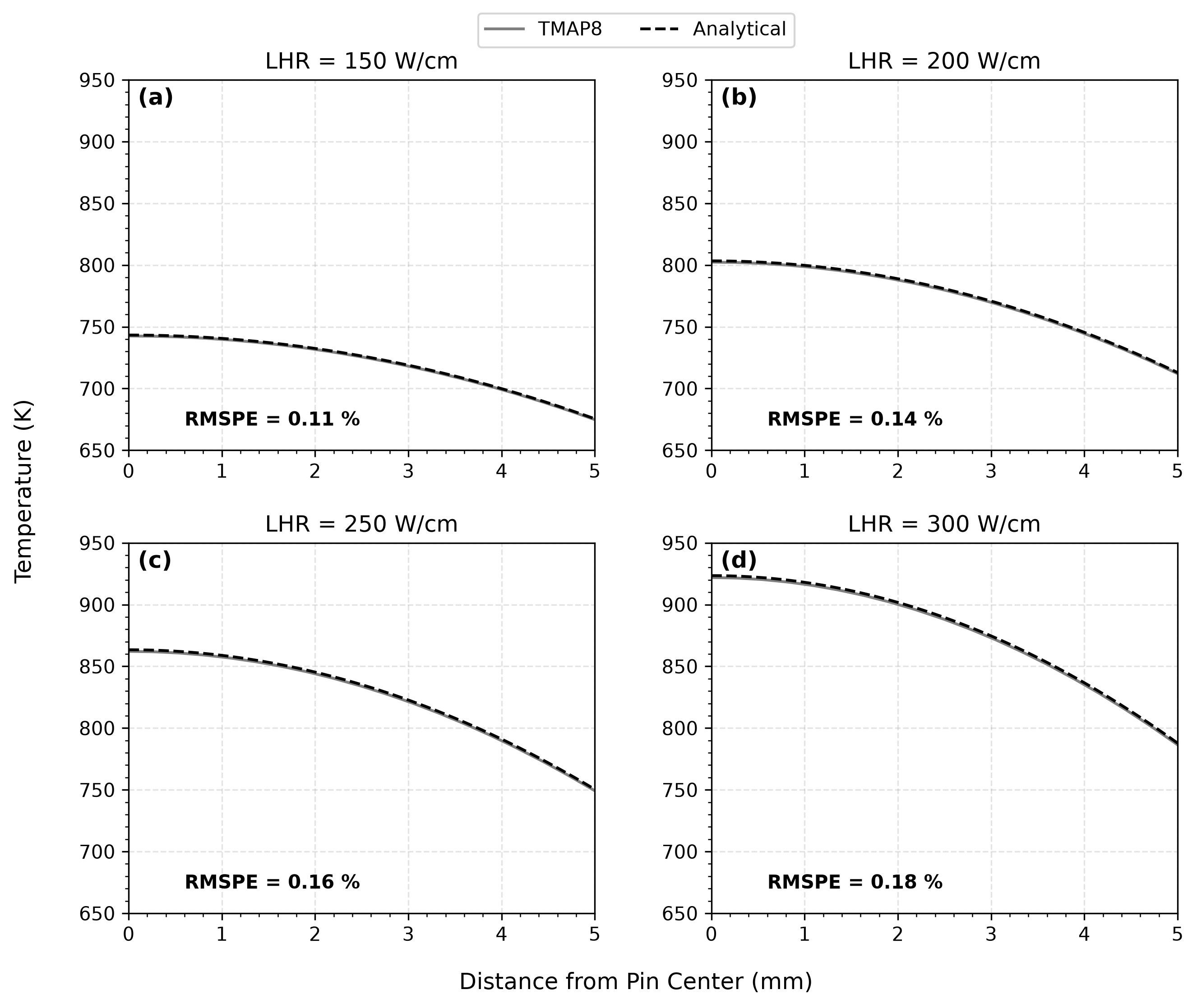
Figure 1: Comparison of TMAP8 calculation with the analytical solution for steady state temperature profile.
Figure 2 shows the comparison of the TMAP8 calculation and the analytical solution for the concentration profile as a function of the distance from the center. The TMAP8 prediction matches the analytical solution with excellent agreement for each linear heating rate, with a maximum RMSPE of 0.02 %. The hydrogen concentration profiles for each linear heating rate were extracted from Fig. 3 in Huang et al. (2000) using an automated plot digitizer and the results are also shown as a comparison.

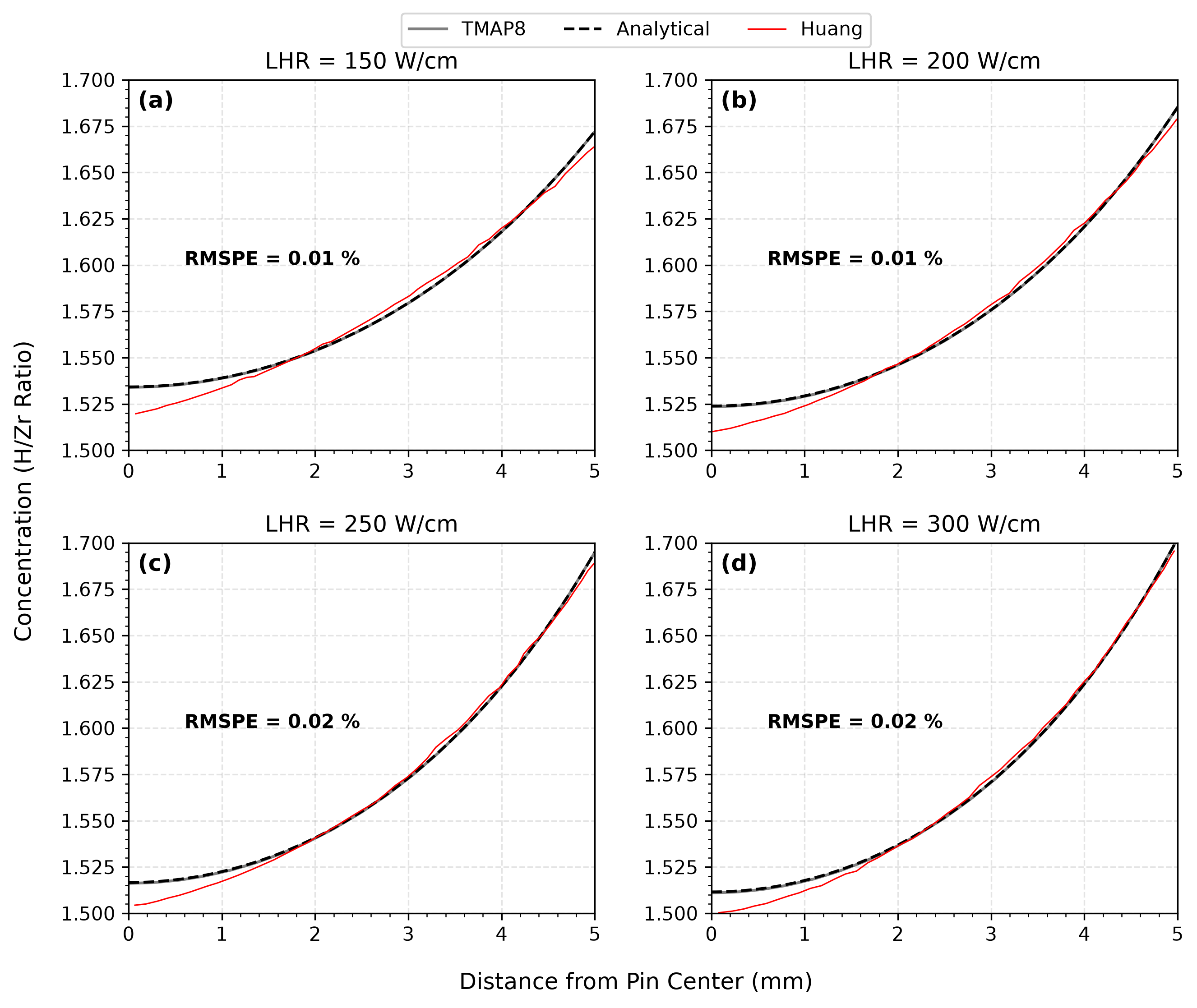
Figure 2: Comparison of TMAP8 calculation with the analytical solution and literature results for steady state concentration profile.
The data reproduced from Huang et al. (2000) does not match with the analytical solution. One potential reason for this disagreement is that extracting the data from the figure in the paper introduces some error. Because the results differ more for the center of the fuel, it is also hypothesized that the boundary conditions were applied differently in Huang et al. (2000). Although Huang et al. (2000) state using a null Neumann boundary condition, which would be consistent with the analytical solution, the results do not consistently show a null flux at the fuel center.
Input files
The input file for this case can be found at (test/tests/ver-1m/ver-1m.i), which is also used as test in TMAP8 at (test/tests/ver-1m/tests).
References
- Philip D. Harvey.
Engineering properties of steel.
American Society for Metals, Metals Park, Ohio, 1982.
ISBN 978-1-62198-480-1.
OCLC: 606485150.[Export]
- Jintao Huang, Bun Tsuchiya, Kenji Konashi, and Michio Yamawaki.
Estimation of hydrogen redistribution in zirconium hydride under temperature gradient.
Journal of Nuclear Science and Technology, 37(10):887–892, 2000.
doi:10.1080/18811248.2000.9714969.[Export]
- G Majer, W Renz, and R G Barnes.
The mechanism of hydrogen diffusion in zirconium dihydrides.
J. Phys.: Condens. Matter, 6(15):2935–2942, April 1994.
doi:10.1088/0953-8984/6/15/015.[Export]
- Stefano Terlizzi and Vincent Labouré.
Asymptotic hydrogen redistribution analysis in yttrium-hydride-moderated heat-pipe-cooled microreactors using DireWolf.
Annals of Nuclear Energy, June 2023.
doi:10.1016/j.anucene.2023.109735.[Export]
- Neil E. Todreas and Mujid S. Kazimi.
Nuclear systems.
Hemisphere Pub. Corp, New York, 1990.
ISBN 978-0-89116-935-2 978-0-89116-936-9 978-1-56032-079-1.[Export]