ver-1n
Voltage-Assisted Transport with Constant Source Boundary Condition
Case Description
This verification case considers one-dimensional deuterium diffusion under an applied voltage through a semi-infinite proton-conducting ceramic (PCC) layer with a constant source at one boundary. PCC materials selectively transport hydrogen isotopes (protium, deuterium, and tritium) at temperatures around 600 C through ionic conduction of hydroxyl defects. This proton-hopping mechanism can be substantially enhanced by applying an electric field, enabling active pumping of hydrogen isotopes across the membrane, even without pressure gradients.
The purpose of this case is to isolate and verify the voltage-assisted migration term in the Nernst–Planck equation. To simplify the comparison with the analytical solution, trapping is excluded, and Sieverts's boundary conditions are imposed on upstream and downstream surfaces.
Case Set Up
This verification case models a one-dimensional PCC membrane with a thickness of 10 mm. The upstream deuterium pressure is held constant, and the corresponding boundary concentration is described by Sieverts' law,
(1)
where is the concentration on the upstream side, is the Sieverts' solubility, and is the upstream deuterium pressure. The downstream concentration is set to 0.
In the PCC membrane, deuterium occupy charged hydroxyl defects. For the voltage-assisted transport verification, the transported deuterium species is treated as a positively charged mobile species with charge number . The Nernst–Planck governing equation is
(2)
where is the concentration of deuterium in the sample, is the deuterium diffusivity, is the Faraday constant, is the ideal gas constant, is the temperature, is the electric potential applied across the sample, and is time. In this verification case, the equation is solved in one dimension, with representing the distance from the source boundary.
The model parameters used in the verification case are shown in Table 1. The deuterium solubility and diffusivity are taken from Hossain et al. (2020). The applied voltage is 20 V across the 10 mm membrane.
Table 1: Values of model properties for the Nernst–Planck verification problem.
| Parameter | Description | Value | Units | Reference |
|---|---|---|---|---|
| gas constant | 8.31446261815324 | J/mol/K | PhysicalConstants.h | |
| temperature | 773 | K | – | |
| deuterium solubility in PCC | 6.38 | atom/m/Pa | Hossain et al. (2020) | |
| upstream pressure | 100 | Pa | – | |
| deuterium diffusivity in PCC | 2.44 | m/s | Hossain et al. (2020) | |
| thickness of PCC sample | 10 | m | Hossain et al. (2020) | |
| Faraday constant | 96485.33 | C/mol | – | |
| voltage applied across PCC sample | 20 | V | – |
The verification focuses on two aspects of the solution: (1) the temporal evolution of deuterium concentration at fixed locations, and (2) the spatial concentration profile at fixed times.
Analytical Solution
Luping and Nilsson (1993) provides the analytical solution for a semi-infinite slab as:
(3)
where
(4)
Here, is the charge number of the mobile hydroxyl defect carrying the hydrogen isotope. The semi-infinite approximation is valid over the simulated time range because the characteristic diffusion length mm remains much smaller than the 10 mm membrane thickness.
Results
Figure 1 compares the TMAP8 results and the analytical solution as a function of time at mm and mm. The TMAP8 calculations closely match the analytical solution at both locations, with root mean square percentage error (RMSPE) values of 0.14% and 0.51%, respectively.
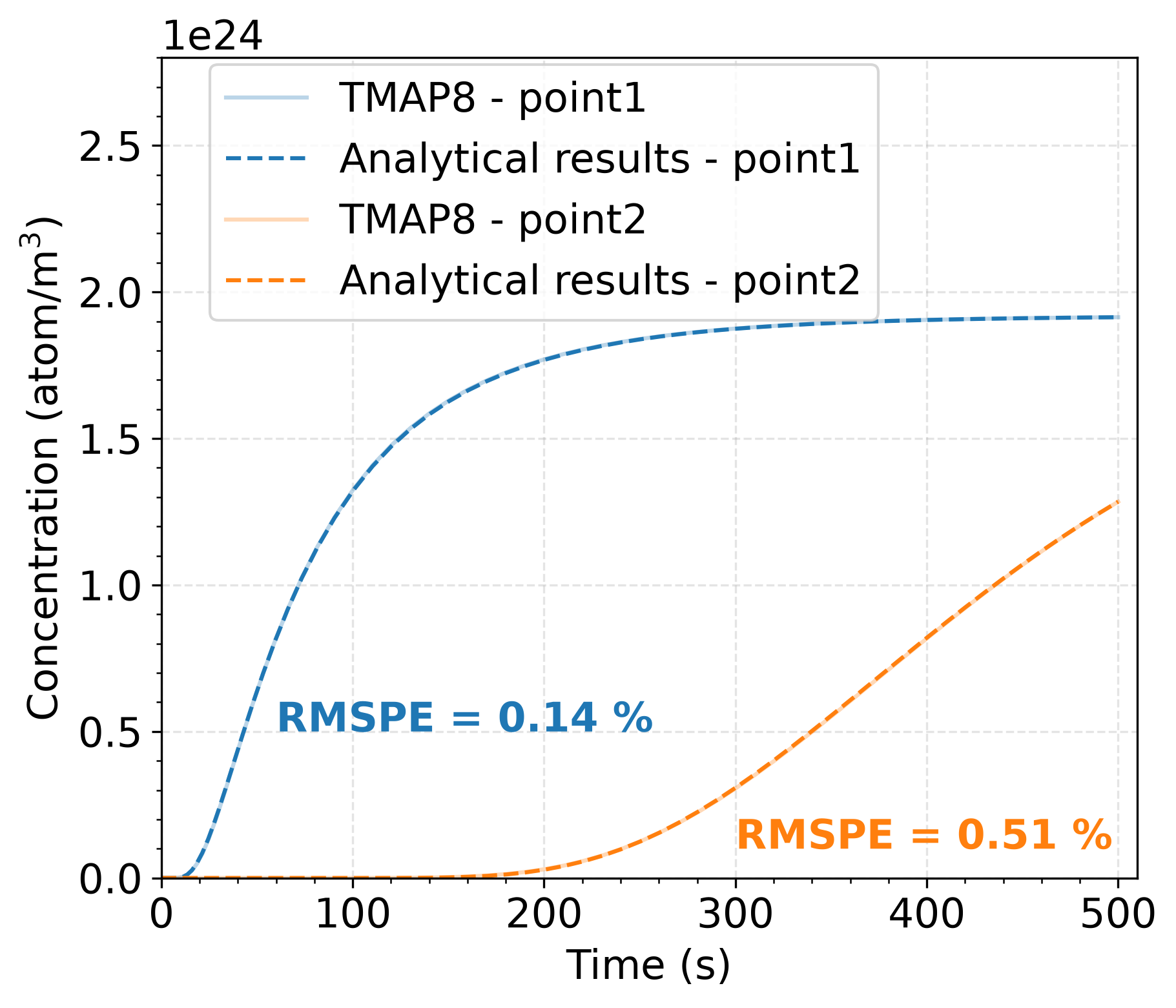
Figure 1: Comparison of deuterium concentration as a function of time at mm and mm calculated by TMAP8 and by the analytical solution.
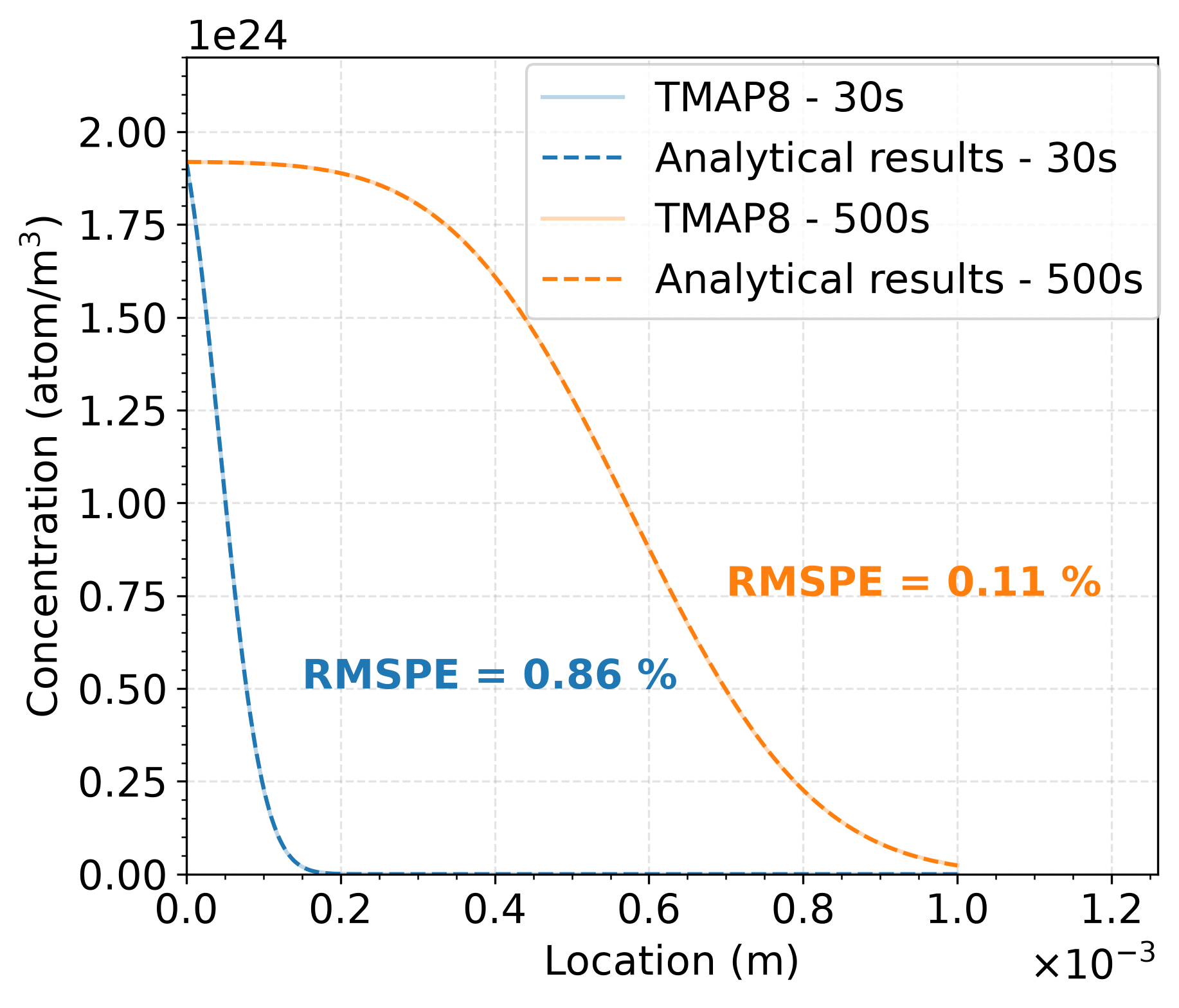
Figure 2: Comparison of deuterium concentration as a function of distance from the source at s and s calculated by TMAP8 and by the analytical solution.
Input Files
The input file for this case can be found at (test/tests/ver-1n/ver-1n.i). More information about how this is used as a TMAP8 test can be found in the test specification file for this case (test/tests/ver-1n/tests).
References
- M Khalid Hossain, Kenichi Hashizume, and Yuji Hatano.
Evaluation of the hydrogen solubility and diffusivity in proton-conducting oxides by converting the PSL values of a tritium imaging plate.
Nuclear Materials and Energy, 25:100875, 2020.[Export]
- Tang Luping and Lars-Olof Nilsson.
Rapid determination of the chloride diffusivity in concrete by applying an electric field.
Materials Journal, 89(1):49–53, 1993.[Export]